













Preparation Phase
- Inspects aircraft and safety equipment.
- Files flight plans and coordinates logistics.
- Schedules maintenance and repairs.
- Conducts pre-flight briefings with crew and passengers.
- Briefs ground crew on safety procedures.
Entry into Flight
- Handles cargo and secures it.
- Communicates with ATC and ground units.
- Monitors weather and updates flight plans.
- Adjusts flight plans as required.
- Verifies all safety and operational checks are complete.
During Flight
- Operates aircraft safely and makes passengers feel secure.
- Engages mission systems if applicable.
- Maintains situational awareness.
- Resolves issues and manages system failures.
- Refuels and handles payments en route.
Emergency & Critical Operations
- Monitors all systems and manages critical failures.
- Handles unforeseen incidents during flight.
- Executes emergency procedures promptly.
- Coordinates with ground support for emergencies.
- Evacuates aircraft if necessary.
Post-Flight Activities
- Conducts debriefings and logs operations.
- Updates maintenance and repair schedules.
- Records incidents and flight data.
- Completes documentation for compliance.
- Coordinates post-flight inspections and repairs.
Additional Responsibilities
- Mentors junior crew members.
- Ensures compliance with regulations.
- Assists passengers and handles inquiries.
- Promotes company brand and services.
- Contributes to close loop feedback for safety and training.
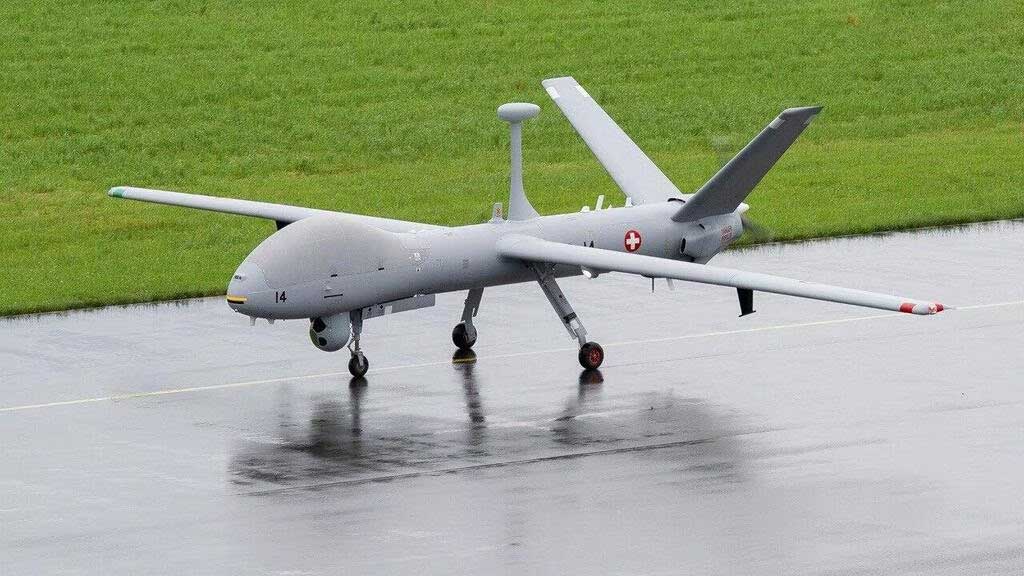
High-value strategic reconnaissance missions and long-range operations often involve advanced drones. The Hermes 900, operated by Swiss Air Force, has a price tag of around USD 40 million per unit and offers a smaller payload than the .
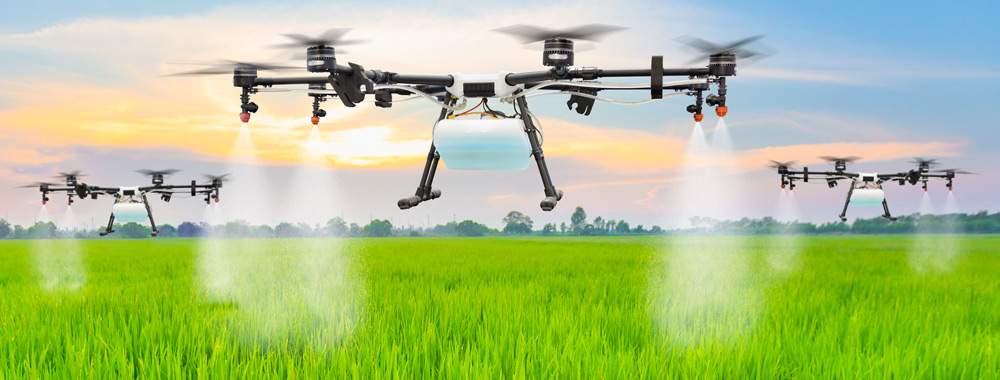
Short-range, GPS-guided, fully automated crop-spraying drones can precisely apply chemicals where needed and operate a few meters above the ground without conflicting with air traffic. For security reasons, these drones are typically operated only by certified (governmental) entities.
team envisions a future that blends aircraft, drones, and other technologies in the sky.
Drone operations transfer flight control to a remote ground station, but all other traditional pilot responsibilities remain. Therefore, operating drones requires additional specialized personnel, advanced technologies, and separate logistics, coordination, and leadership.
As a result, drone operations are more complex and costly, demanding sophisticated coordination, secure and fail-safe flight controls and communication systems, sense-and-avoid technology, and enhanced safety protocols and redundancy to mitigate potential failures and risks.
High effectiveness, efficiency and resilience depend on system interoperability, joint operations and an optimal mix of technologies aligned with mission requirements, constraints and the long‑term needs and capabilities of the operator or nation.
Therefore, discussions about drones replacing piloted aircraft overlook the fundamental point in the overall analysis. In summary, the benefits of piloted operations outweigh those of pilotless drones for most use cases.
The radar charts provides an overview of performance and suitability for various missions. While it serves as a comparison that may seem like "apples and oranges," it effectively highlights the strengths of and clearly demonstrates its versatility and utility. The charts should be interpreted qualitatively; for more precise information, please contact us.
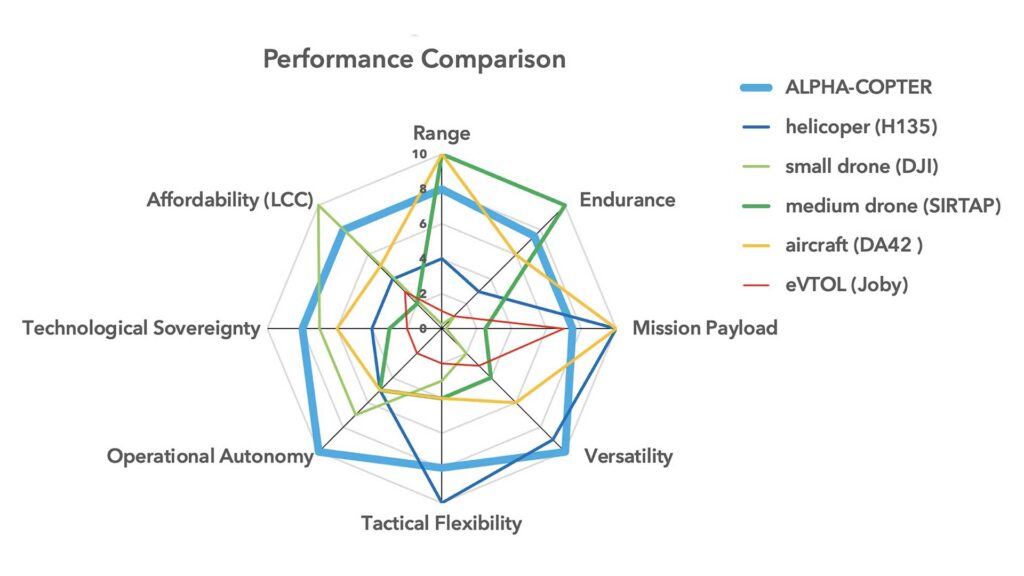
Range: The maximum distance a vehicle can travel on a single charge or tank of fuel. The twin-engine can operate far beyond the range limitations of conventional helicopters.
Endurance: The total time a vehicle can remain airborne before needing to refuel or recharge, including reserve time. will outperform all helicopters in endurance.
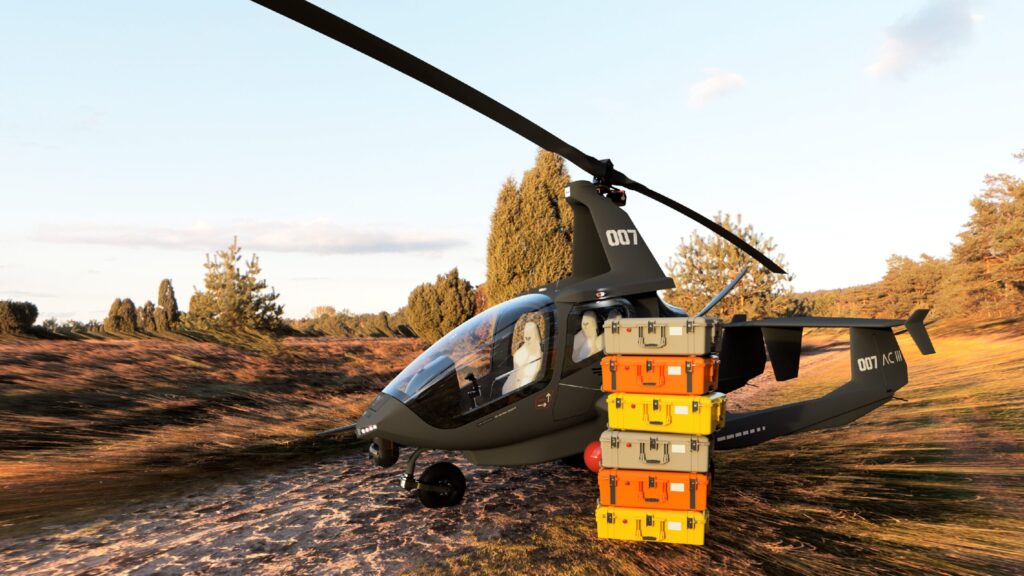
Mission Payload: The maximum weight a vehicle can carry, including passengers, cargo, mission equipment, and weapon systems. features a medium payload capacity ideal for supporting mobile units.
Versatility: The capability to conduct various mission types without significant downtime for reconfiguration. is engineered for versatility and can adapt to changing mission needs.
Tactical Flexibility: The ability to quickly adapt in-flight to different mission types and operational changes. can rapidly adjust in real-time with its onboard pilot and tactical flight officers.
Operational Autonomy: The extent to which a vehicle can operate independently without external control or infrastructure. is designed to operate from a Forward Operating Base (FOB), extending the reach of special or expeditionary forces.
Technological Sovereignty: The capacity to develop, utilize, and control technology independently.
Full control: can operate without foreign dependencies or vulnerabilities.
Affordability (LCC): The total cost of ownership and operation throughout the vehicle's lifecycle. offers lifecycle costs comparable to those of ground vehicles, rather than aircraft.
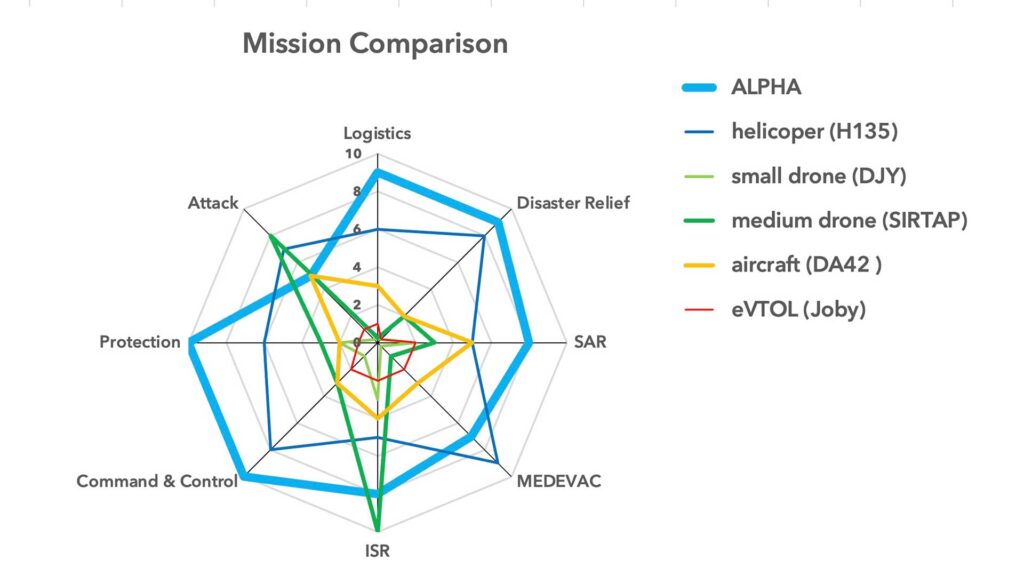
Logistics: The movement and storage of goods and personnel for efficient operations. facilitates rapid supply transport in challenging environments.
Disaster Relief: Humanitarian support during and after disasters when traditional infrastructure is compromised. is designed to deliver aid in austere conditions.
SAR (Search and Rescue): Operations to locate and assist individuals in distress. is built for extensive search operations across vast areas.
MEDEVAC (Medical Evacuation): Transporting injured or ill individuals to medical facilities. ensures timely medical evacuations with its range and quick response capabilities.
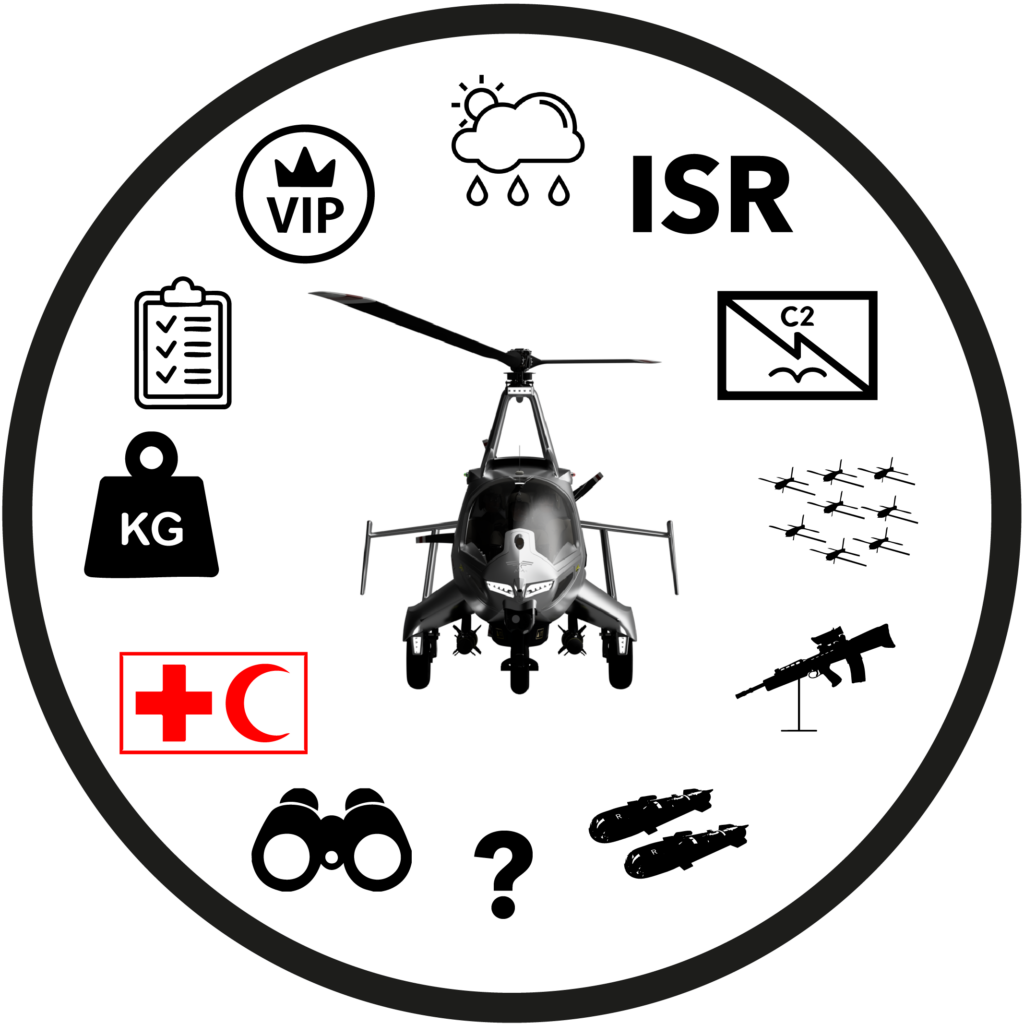
ISR (Intelligence, Surveillance, and Reconnaissance): The collection and analysis of information for strategic decisions. conducts discreet operations, gathering valuable intelligence without alerting potential threats.
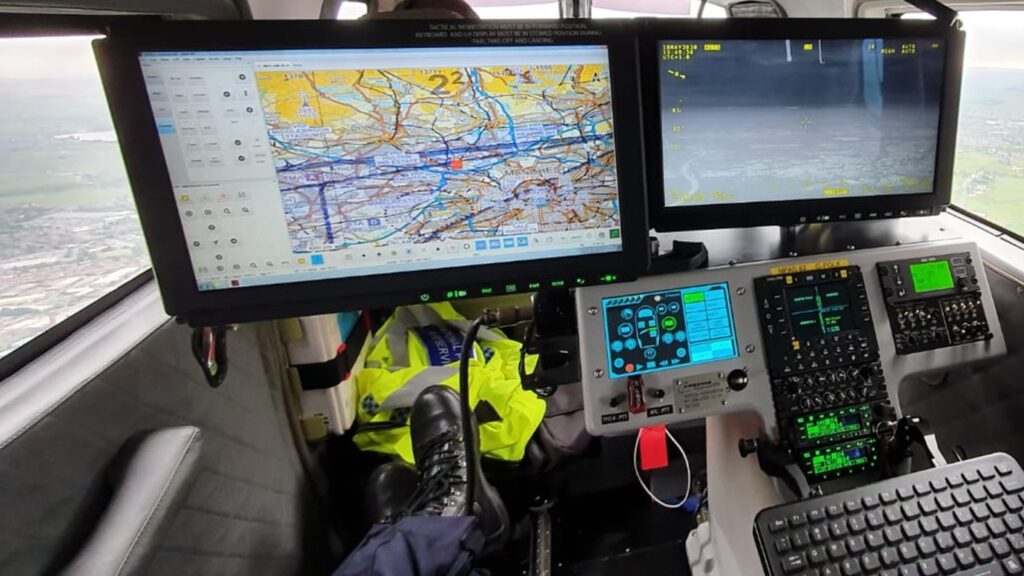
Command & Control: Directing forces and resources to achieve objectives. enhances situational awareness and supports up to 2 tactical flight officers onboard.
Protection: Safeguarding personnel and resources from threats. is tailored for security and anti-drone missions, ensuring safe transport and convoy escort in high-risk areas.
Attack: Offensive actions taken against targets to meet military objectives. 's hardpoints allow for precision strikes, neutralizing threats while minimizing collateral damage and military footprint.
Our team envisions the future of air operations as an integrated 'system of systems' across all domains. Therefore, it is crucial to select the appropriate technology for each mission to optimally balance safety, effectiveness, cost-efficiency, resilience, sustainability, and other parameters.
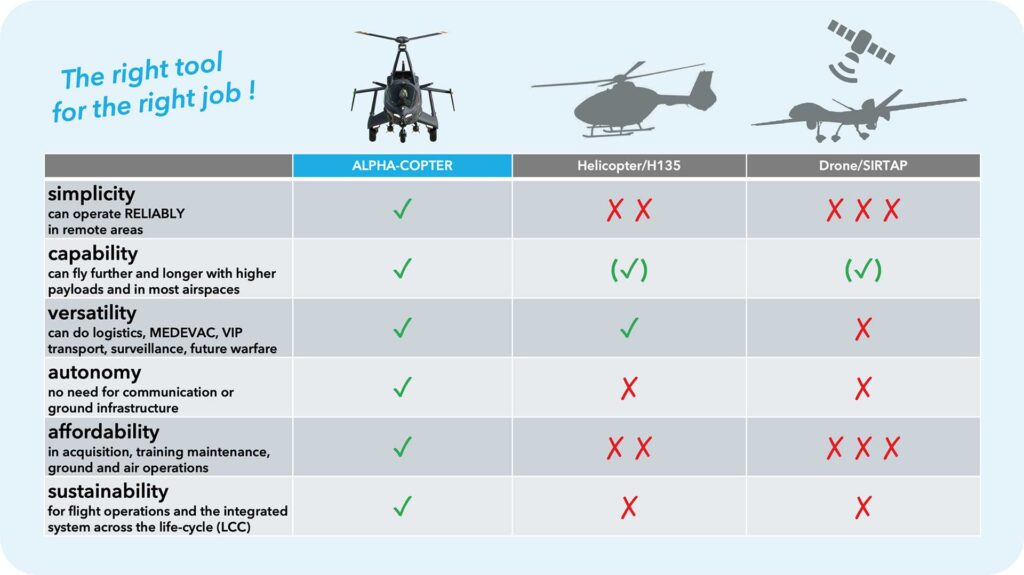
, helicopter or drone?
Let’s compare different technologies and consider a mission scenario where a specific area needs to be monitored to prevent smuggling and territorial violations.
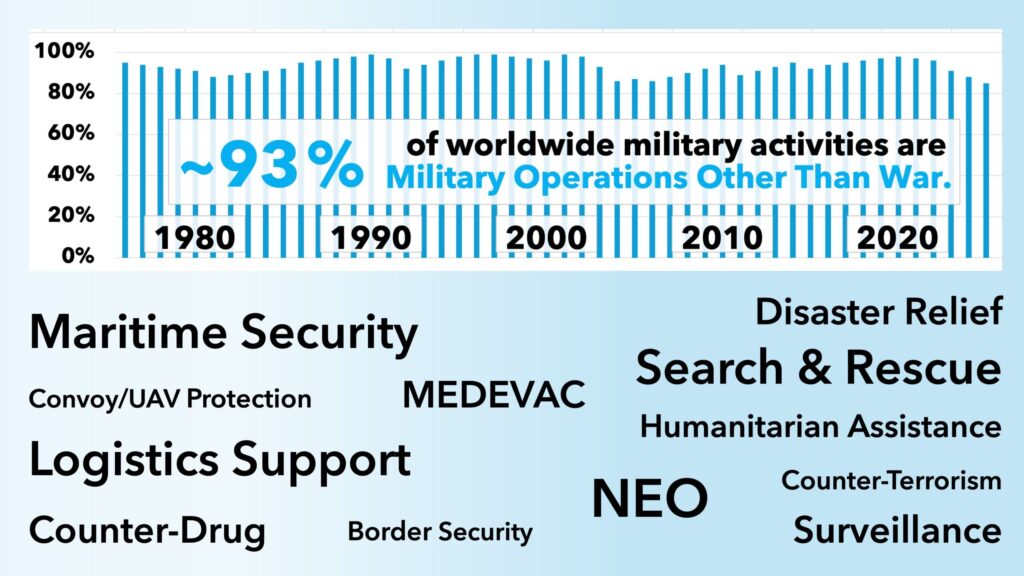
- Security Situation: Aligned with Military Operations Other Than War (MOOTW)
- Missions: Surveillance, Patrolling, Armed Interception
- Theatre of Operations: Including flying over city, sea and forest; twin-engine aircraft required
- Duration: Continuous presence for one month, 24/7
- Nearest Airfield: Located 200 km away from the Theatre of Operations (ToO)
- FOB (Forward Operating Base) with a TLZ (Temporary Landing Zone, e.g., a soccer field or beach area), located 100 km from the ToO.
| (twin-engine) | Helicopter (e.g. H135) | Drone (e.g. MALE/SIRTAP) |
|---|---|---|
| FOB-based operations and maintenance | Can be refuelled at the FOB; requires maintenance at airfield | Requires airfield and communication infrastructure |
| Endurance: 8 h; Speed: ~200 km/h; Range: 1,500 km | Endurance: 3 h; Speed: ~200 km/h; Range 600 km | Endurance: 18 h; Speed: ~200 km/h; range: 2,200 km |
| Operational availability: 90% | Operational availability: 70% | Operational availability: 80% |
| 6-hour orbiting in Theatre of Operations (ToO), with 1h commute and 1h reserve. | 1-hour orbiting in Theatre of Operations (ToO), with 1h commute and 1h reserve. | 15-hour orbiting in Theatre of Operations (ToO), including 2h commute and 1h reserve. |
| 120 flight missions per month with (30d*24h/6h) 840 hours | 720 flight missions per month with (30d*24h/1h) 1,440 hours | 48 flight missions per month with (30d*24h/15h) 816 hours |
| Minimum requirement: 3 ALPHA-COPTERs required | Minimum requirement: 4 helicopters required | Minimum requirement: 3 drone systems required |
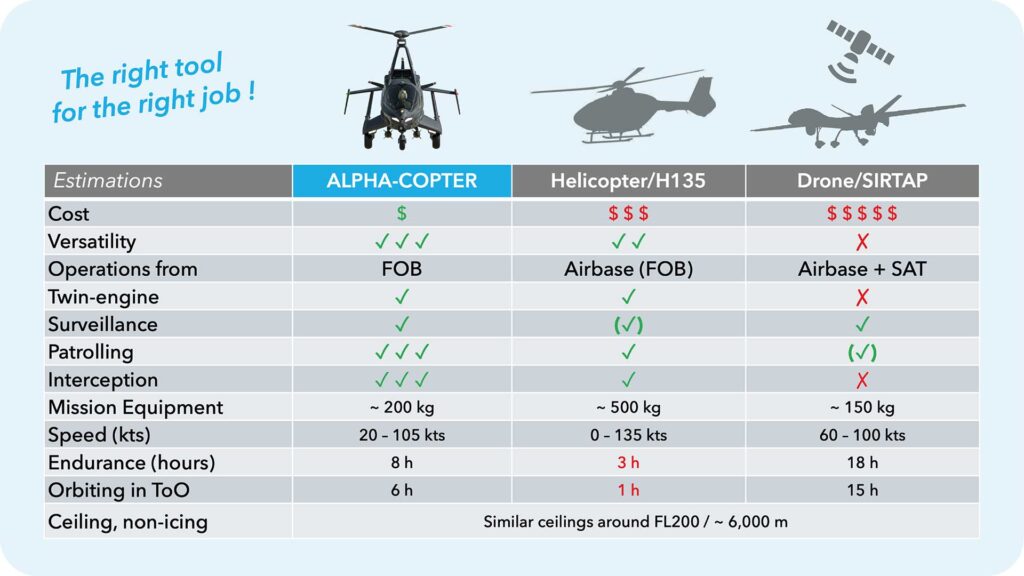
The three distinct systems are designed with different strengths. stands out for its versatility and cost-efficiency, while helicopters excel in hovering capabilities, and certain drones provide extended flight durations. It's important to note that international rules of engagement typically restrict drones from conducting interception missions; however, they are often very effective in surveillance and attack operations.
Remark
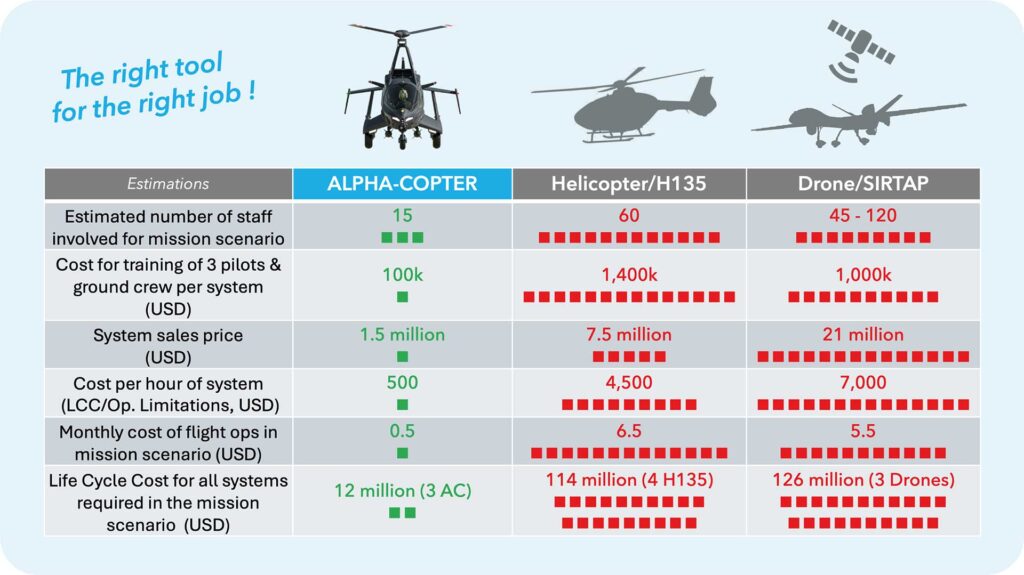
LCC (Life Cycle Cost) includes all expenses, such as fuel, maintenance, add-ons, crew training and salaries, hangar costs, insurance, depreciation, and other related costs incurred over the lifespan of the asset.
Optimized Multi-Platform Air Operations
In future MOOTW and asymmetric warfare scenarios, the dynamic and agile deployment of air assets is critical. This integrated approach optimizes effectiveness, efficiency, and resource management. It also ensures proper de-escalation and enhances force scalability.
The acts as a key force-multiplier. It operates across most airspaces, crewed by a pilot and one to two Tactical Flight Officers. Its power capacity, similar to twin-engine helicopters, supports drone jammers, weapon systems and various sensor pods. This enables integrated on-board data collection and processing.
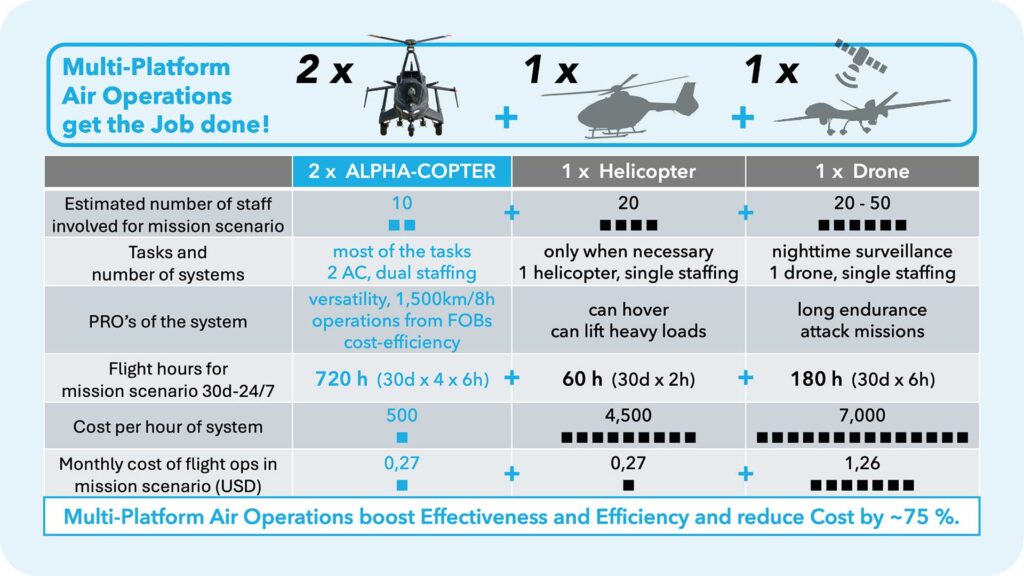
This capability directly enhances the Digital Common Operational Picture (COP), a critical enabler for Network-Centric Warfare (NCW). Consequently, the reduces the operational burden on other platforms. A typical strategy uses for patrolling, force projection, and interception tasks.
Drones provide (nocturnal) surveillance, particularly when interception requirements are diminished. Helicopters remain on constant standby for tasks requiring heavy lift or hovering capabilities. This combined strategy guarantees sustained operational endurance and the preservation of strategic assets.
Efficiency is the ability to achieve maximum productivity while minimizing wasted resources, emphasizing the optimization of processes—essentially, the effective use of fuel, equipment, money, manpower, and more.
Effectiveness, on the other hand, focuses on successfully achieving intended goals and objectives, ensuring that tasks are completed as required.
Combining Efficiency and Effectiveness
Ensuring resource-efficient and goal-oriented operations – does outperform helicopters?
excels in efficiency across nearly all scenarios, with exceptions for transporting heavy loads or hovering. However, research among military and civilian operators indicates that these specific operations are relatively rare, occurring in only 10% to 40% of helicopter flights, depending on the operator.
In terms of effectiveness, the excels in longer flights, offering greater payload capacity due to its minimal fuel consumption, and the ability to fly twice as long and twice as far as helicopters. This is illustrated in the accompanying graphic:

Beyond operational performance, also presents significant advantages in long-term cost-efficiency regarding licensing. pilots require approximately three months and costs around USD 20,000 — a mere fraction of the expense and time involved in training a helicopter pilot with a twin-engine rating.
Yet, robust staff pool build-up demands strategic planning, requiring early stakeholder integration, regulatory alignment, and rigorous selection of instructors and future ground and air crew. Despite accelerated individual qualification, establishing a resilient pilot pipeline requires comprehensive organizational and instructional infrastructure, a multi-year endeavour.
 English
  German
  French
  Spanish
  Indonesian